Where the standard
runs out.
Some work does not fit into a product you can buy. That is where a system gets built — one that follows the actual process instead of bending it.
Talk it through →Three situations
we keep meeting.
The industry has no software
Every trade has its own logic — its own units, its own contracts, its own way of quoting. Where the market only offers something generic, a solution built for that trade pays for itself quickly.
The tools no longer talk
Shop, warehouse, accounting, CRM — each system on its own is fine, but the numbers are copied by hand between them. Interfaces turn a stack of islands back into one flow.
The spreadsheet has outgrown itself
It started as one table and now it runs the company — with three people who know how it works. Time to move it somewhere it can be maintained, backed up and handed over.
A retail system
for a niche market.
store.Guru is a POS and ERP system for the diving trade — catalogue, variants, stock, loyalty and the shop, all in one place. It exists because the industry's suppliers sell sizes, air volumes and service intervals that no standard system knows about.
More of our work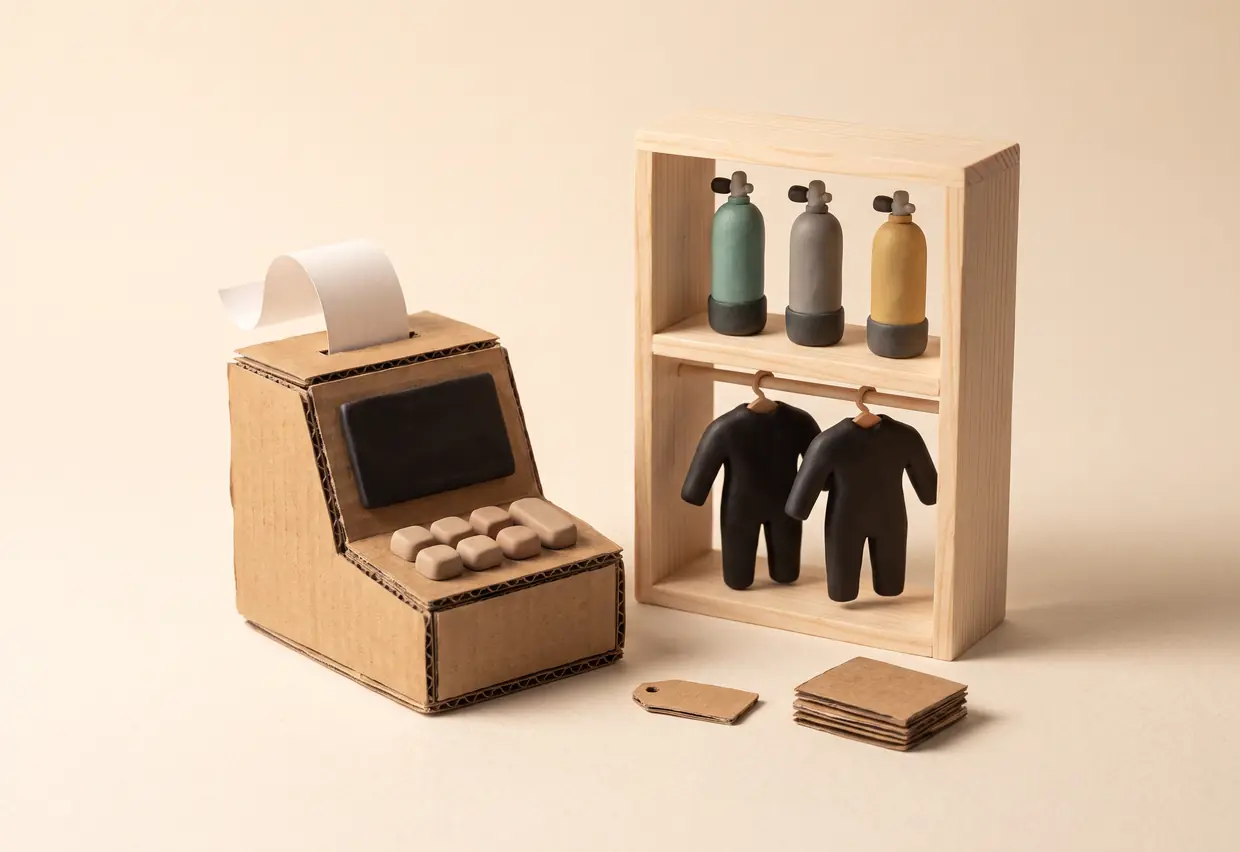
The right tool,
not the favourite one.
Before a line of code is written, a handful of questions decide most of the architecture. We would rather ask them out loud than guess.
How far does it have to grow?
A tool for eight people in the office is built differently from a platform expecting peaks of thousands. Both are fine — building the first one like the second is not.
What shape is the data?
Strictly relational, or rather document-oriented? The answer decides the database, and the database decides what will be easy later and what will hurt.
What has to connect?
Accounting, ERP, payment providers, shipping, an existing shop. Interfaces are rarely the exciting part of a project and almost always the part that decides whether it works.
Who maintains it in three years?
Boring, proven technology beats the interesting choice. Anything we build should still be readable by someone who was not there when it was written.
Software is not
a delivery.
A system that runs the business needs someone who keeps it running — updates, monitoring, backups and a phone number that gets answered. We host most of what we build ourselves, in Bern.
Our datacenterUnderstand. Plan.
Build. Grow.
The same four stages apply to a small internal tool and to a system a company runs on. How long each takes depends on the project — that they all happen does not.
How we workWhat else
we work on.

Describe the problem,
not the solution.
The first conversation is about what is in the way — the technology comes later, and often looks different from what everyone expected.